


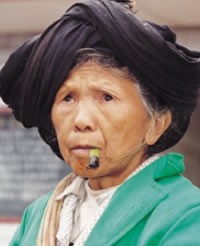

The Haoni are counted as part of the Hani nationality in China, but they speak their own distinct language.
The Haoni people have a long history. They were originally part of a larger group known as Heman or Heni during the Tang Dynasty (AD 618-907). These names are still sometimes used today by the various Hani groups. In 1917 the Haoni joined forces with the local Miao and Tai in a five-year battle against oppressive landlords.
The Haoni live in a harsh environment where it is difficult to grow the food they need. They have long been a poverty-stricken people. In 1955 when the communist authorities in Mojiang sent cadres to investigate the Haoni, "the sight of abject poverty horrified the investigators. Most of the children were stark naked, and the rags they possessed were hardly enough to go around for adults. Eight villagers of the age of 20 had literally no clothes to wear and six of them were females. One family's belongings amounted to no more than a small iron pot and an earthenware bowl." Today economic improvement has come to the Haoni in the valleys, but the plight of those dwelling on the mountaintops remains poor.
The Haoni are rapidly becoming a secularized people. Few of the younger generation observe the intricate superstitions of their parents and grandparents. Traditionally the Haoni were slaves to a multitude of demons and ghosts. This has helped shape the worldview of the Haoni. Some believe "a man's body has nine souls located in the head, mouth, heart, eyes, chest, hands, ears, back and feet; a woman's body, however, has one more soul located in her breasts."
Mojiang County was the center of activity for the German Pentecostal Vandsburger Mission and the Danish Assemblies of God. Between 1940 and 1947 a massive people movement to Christ flourished throughout the area, especially among the Biyo and Kado. Forty thousand tribesmen - 35% of the entire minority population at the time - started following Christ. H. A. Baker, an independent Pentecostal missionary, also ministered widely in the area.
Today there are Haoni Christians who meet in scattered churches throughout Mojiang County. Most Haoni use the Chinese language in their services because there has never been any translation work completed in the Haoni language of southern Yunnan.
The Haoni people still face issues of dire poverty.
Pray for the Lord to provide for the Haoni people, especially those who are living in impoverished mountain villages.
Pray for the Lord to use the Haoni people as an example of what happens to a people who are blessed by the Lord.
Pray for the Holy Spirit to move mightily among the Haoni people, driving them to take the gospel to others Yunnan Province.
Scripture Prayers for the Haoni in China.
Operation China, Asia Harvest, Copyrighted © Used with permission
| Profile Source: Joshua Project |



