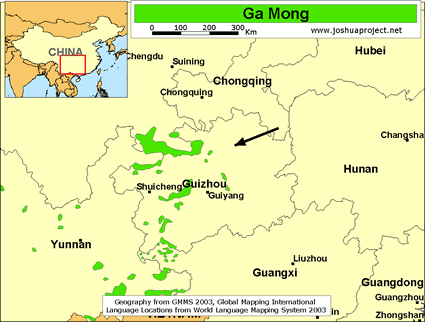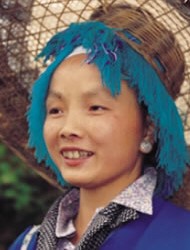

The Ga Mong are a distinct ethnic minority living primarily in Guizhou Province in southwestern China. They were historically classified by the Chinese government under the larger Miao nationality and were commonly called Dong Jia by local Chinese populations. In 1997 they were administratively reclassified under the She nationality, a change many Ga Mong opposed because they considered themselves a separate people with their own language, customs, and identity.
The Ga Mong speak their own Hmongic language, which belongs to the Hmong-Mien language family and is more closely related to western Hmong varieties than to many nearby Miao groups. Their villages are mainly scattered across parts of central Guizhou, especially around Kaili, Duyun, Majiang, Longli, and Xiuwen counties.
According to their own traditions, the Ga Mong trace their history back to the Song Dynasty. Historical accounts describe them as a strong and independent people who defended their territory during the Ming Dynasty and at times fought major regional conflicts against Chinese authorities.
Despite increasing modernization and government integration, the Ga Mong have continued to preserve a distinct identity through language, festivals, clan structures, and traditional customs.
Many Ga Mong families live in rural mountain communities where farming, livestock care, forestry work, and seasonal labor support daily life. Rice, corn, vegetables, and locally raised animals form important parts of the traditional diet.
Village life remains strongly centered around family and clan relationships. Cooperation between households is important for farming, celebrations, and community activities. Extended family ties continue to influence marriage customs, social responsibilities, and local leadership.
The Ga Mong are known for preserving unique festivals and ceremonies distinct from surrounding peoples. One major annual celebration occurs on the eighteenth day of the tenth lunar month and includes communal feasting, bullfights, cockfights, music, and social gatherings.
Like many rural minority communities in Guizhou, younger generations sometimes leave villages for work and education opportunities in larger towns and cities. Economic limitations, uneven healthcare access, transportation difficulties, and preservation of traditional language and identity remain ongoing challenges for some communities.
The primary religious practice among the Ga Mong is ancestor worship. Nearly every home traditionally contains an ancestral altar where offerings and ceremonies are performed to honor deceased family members. The Ga Mong believe ancestors continue to influence the living and therefore must be respected carefully.
Food and drink offerings are commonly presented several times each year in ceremonies intended to provide for ancestors in the spiritual world and maintain harmony between the living and the dead. Actions believed to offend ancestors are considered extremely serious matters within the community.
Some Ga Mong communities also practice forms of animism and folk religion, including beliefs connected to spiritual forces and traditional supernatural beings. Historical reports mention the presence of the "heaven-dog religion," likely connected to worship traditions associated with Pan Hu found among some Yao groups in southern China.
Very few Ga Mong have had meaningful exposure to biblical Christianity. Many still have little opportunity to hear a clear explanation of salvation through Jesus Christ alone.
The Ga Mong need greater access to faithful Christian witness communicated clearly within their cultural and linguistic setting. Many live in spiritually neglected areas where there has been little long-term gospel outreach.
There is a need for believers willing to serve patiently among minority communities in Guizhou, learn local customs and language patterns, and disciple those who may face social pressure for following Jesus Christ. Access to Scripture, Christian teaching materials, and healthy fellowships is important for long-term spiritual growth.
Practical needs also remain significant in many mountain communities, including healthcare access, educational opportunity, economic development, and support for isolated rural families. Compassionate Christian ministry can help demonstrate the love of Christ while opening doors for meaningful gospel conversations.
The Ga Mong would benefit from strong local churches capable of discipling believers, strengthening families, and continuing to share the gospel throughout central Guizhou and neighboring minority regions.
Pray for the Ga Mongs to be adopted through the People Group Adoption program leading to regular prayer and faithful outreach.
Pray that God will raise up faithful Christian workers who are willing to serve among the Ga Mong with wisdom, humility, endurance, and compassion.
Pray that the Ga Mong people will be adopted through the People Group Adoption program so that sustained prayer, outreach, discipleship, and future gospel engagement will continue among them.
Pray that believers among the minority peoples of Guizhou will grow strong in biblical faith and boldly share the truth of Christ with neighboring communities.
Scripture Prayers for the Ga Mong in China.
https://people-groups.asiaharvest.org/China/chinaPeoples/G/GaMong.pdf
https://en.wikipedia.org/wiki/Hmong_people
https://www.mnhs.org/hmong/hmong-timeline
https://www.hmongamericancenter.org/hmong-history/
https://en.wikipedia.org/wiki/Gejia_people
| Profile Source: Joshua Project |