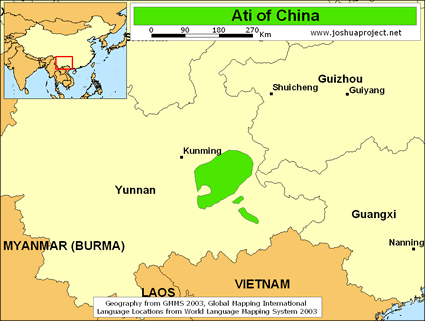

Several hundred years ago, tribes like the Ati lived relatively uninterrupted lives in the hills of central Yunnan. The Han Chinese then flooded the area in massive waves of migration, especially over the last 150 years. Today groups like the Ati, swamped amid the sea of Han Chinese, are barely noticeable to outsiders. As the Han grew in numbers and influence, they forced the Ati off the best land and into the mountains. The Ati were forced to move in order to retain their own customs and ethnicity. Those who stayed in the rural areas were soon absorbed culturally and linguistically.
The Ati are one of dozens of distinct tribes and ethnolinguistic groups the Chinese authorities combined to form the official Yi nationality. There are 120 distinct subgroups of Yi in China. The Ati are only distantly related to other Yi groups in the area, such as the Axi, Adu, Long, Xiqi, and Sani.
The Ati share many cultural traits with the Adu, Long, and Xiqi groups who also inhabit Huaning County and speak Yi languages. The Ati live in two-story wooden homes that are built as a safeguard against intruders and wild animals. Most Ati are engaged in agriculture, but in recent years many youth have ventured into the cities and towns of Yunnan looking for work. Those fortunate enough to gain employment send most of their income home to support their families.
The Ati are ardent animists and polytheists. In particular they revere and worship the Dragon god. Most Ati villages have a "dragon tree" set aside for this purpose. The antireligion and anti-superstition campaigns of the Cultural Revolution (1966-1976) caused many Ati rituals to cease. As government opposition has eased, the Ati have slowly revived their former beliefs.
A Chinese government survey in 1989 found there to be 23 Christians among the Yi in Huaxi District of Huaning County. These are probably people from the Ati tribe. Little mission work was done in this part of Yunnan Province, although some Catholic endeavors may have resulted in the small amount of fruit that remains today. Despite the presence of these few families of believers, most Ati are completely unaware of the gospel.
The Ati people need to submit to Jesus Christ so they can experience the abundant life he offers them in John 10:10.
Pray for the authority of Christ to bind hindering spiritual forces to lead them from darkness to light.
Pray for signs and wonders to happen among them and for great breakthroughs with a rapid multiplication of disciples and house churches.
Pray for bold workers who are driven by the love of the Holy Spirit to go to them.
Pray for an unstoppable movement to Christ among them.
Scripture Prayers for the Ati in China.
Operation China, Asia Harvest, Copyrighted © Used with permission
| Profile Source: Joshua Project |