




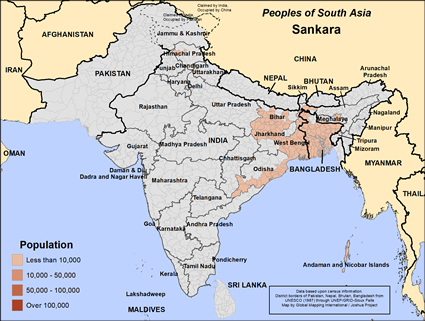
The Sankara are a people group found in India, though very little detailed public information is available about their history and culture. They are part of the complex mosaic of communities that developed over centuries across the Indian subcontinent through migration, regional isolation, clan identity, and occupational traditions. Like many smaller communities in India, their identity is closely tied to language, family heritage, and local social structures. Their daily life and traditions have likely been shaped by the surrounding regional cultures while still preserving distinct customs within their own community.
Because specific published information about the Sankara is limited, much of their daily life appears to follow patterns common among traditional Indian communities. Family relationships are highly valued, and households often include strong ties between parents, children, and extended relatives. Community reputation, marriage customs, and social obligations typically play an important role in maintaining stability and identity.
Livelihoods may include agriculture, local trade, labor, or small-scale business depending on the region where they live. Food habits are likely influenced by local Indian cuisine, with meals centered around grains, rice, lentils, vegetables, and regional spices. Festivals, weddings, and religious observances often serve as major social gatherings that reinforce community bonds and cultural continuity.
In many Indian communities, younger generations are increasingly exposed to urbanization, education, and modern technology, creating both opportunity and tension between traditional expectations and contemporary life.
The Sankara are associated with Hindu religious traditions. Hindu belief and practice in India commonly involve devotion to various deities, temple rituals, family gods, festival observances, and ceremonies connected to birth, marriage, and death. In many communities, religious life may also include elements of folk religion, ancestor reverence, local spirits, astrology, ritual purity practices, and the guidance of priests or spiritual leaders.
Although Hinduism contains many philosophical systems and devotional paths, its teachings do not provide reconciliation with the one true God through Jesus Christ. Many people continue seeking spiritual merit, blessing, protection, or freedom from suffering through ritual observance and religious duty rather than through the saving grace of the gospel.
The Sankara need faithful gospel witness in both word and deed. Many have little or no meaningful exposure to biblical Christianity presented in their own cultural context. Access to Scripture, trained Christian workers, and long-term discipleship is still needed among many communities in India.
Practical needs may also include improved education, healthcare access, economic opportunity, and encouragement for families facing social and financial pressures. As modernization changes traditional ways of life, many communities struggle to balance cultural identity with changing economic realities.
There is also a need for mature local believers who can clearly communicate the gospel, disciple new Christians, and lovingly engage their communities with biblical truth.
Pray that the Sankara people would hear a clear presentation of the gospel and respond in faith to Jesus Christ.
Pray that God would raise up strong local believers and gospel workers who will faithfully share Scripture with the Sankara community.
Pray that the Sankara would be adopted through the People Group Adoption program so that sustained prayer, outreach, and long-term gospel engagement would take place among them.
Pray for wisdom, provision, education, and practical help for families within the Sankara community, and that these needs would open doors for lasting Christian witness.
Scripture Prayers for the Sankara in India.
https://en.wikipedia.org/wiki/Sankethi_Brahmin
https://en.wikipedia.org/wiki/Banjara_people
https://en.wikipedia.org/wiki/Kadar_people
| Profile Source: Joshua Project |



