




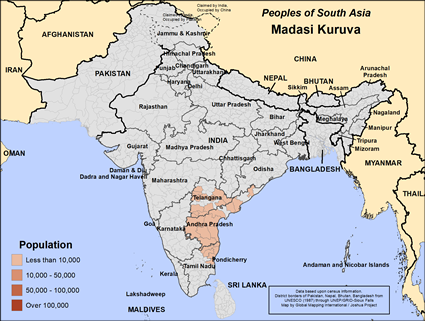
The Madasi Kuruva are a Telugu-speaking community found primarily in the southern Indian states of Andhra Pradesh, Telangana, and parts of Tamil Nadu. Traditionally, they have been associated with sheep and goat herding, a livelihood that has shaped their social identity and daily life for generations. Their community belongs to the broader network of pastoral groups in South India connected to shepherding and animal husbandry traditions.
The Madasi Kuruva have historically occupied a low social position within the caste structure of Indian society. In recent decades, there has been continuing debate and political activism regarding their official caste classification and access to social benefits available to disadvantaged communities. Despite social and economic challenges, the community has maintained strong family ties and cultural traditions rooted in rural village life.
Their heritage is linked to the wider Kuruba and Kuruva pastoral traditions of South India, communities historically known for shepherding, animal care, and agricultural labor.
Many Madasi Kuruva families still depend on sheep and goat herding for their livelihood, especially in rural parts of Andhra Pradesh and Telangana. Others work as agricultural laborers, construction workers, small traders, or daily wage earners. Economic conditions can be difficult, particularly for families with limited land ownership or educational opportunities.
Life often revolves around caring for livestock, seasonal movement for grazing, and village-centered community relationships. Extended families usually remain closely connected, and respect for elders is important within the community. Marriages are commonly arranged with strong family involvement, and preserving community identity remains highly valued.
Food commonly includes rice, millet, lentils, vegetables, and locally available foods typical of Telugu-speaking regions. Rural families may also depend heavily on seasonal agricultural cycles and livestock income. Religious festivals, weddings, and community gatherings are major social events that reinforce cultural identity and family ties.
Access to healthcare, stable employment, quality education, and infrastructure can remain limited in poorer rural areas. Younger generations increasingly seek opportunities in towns and cities, though many still maintain close ties to their home communities and traditional way of life.
The Madasi Kuruva primarily follow Hindu traditions shaped by both mainstream Hindu worship and local folk religious customs. Their religious life may include devotion to Hindu gods and goddesses through temple worship, household shrines, offerings, fasting rituals, and festival observances.
Like many rural communities in South India, religious practices may also include syncretistic elements involving village deities, ancestral customs, astrology, protective rituals, and fear of harmful spiritual forces. Religion is closely connected to daily life, family events, agricultural seasons, and community identity.
Major Hindu festivals such as Diwali, Holi, Navratri, and Rama Navami are commonly observed within the broader regional culture. Most Madasi Kuruva have had little exposure to a clear biblical presentation of the gospel and may know very little about Jesus Christ beyond general cultural awareness.
The Madasi Kuruva need faithful access to the gospel through Scripture, discipleship, and long-term Christian witness presented in culturally understandable ways. Because family and community loyalty are strong, individuals who become interested in following Christ may face social pressure or rejection.
Practical needs include improved healthcare access, educational opportunities, vocational training, and economic stability for struggling rural families. Communities dependent on livestock and agricultural labor can face financial uncertainty due to drought, changing markets, and limited employment opportunities.
There is also a need for spiritually mature local believers who can establish biblically grounded churches and faithfully share the gospel among neighboring Telugu-speaking communities.
Pray that the Madasi Kuruva people will hear a clear and understandable presentation of the gospel in the Telugu language.
Pray that God will raise up compassionate Christian workers who are willing to serve faithfully among the Madasi Kuruva community.
Pray that the Madasi Kuruva people will be adopted through the People Group Adoption program so that ongoing prayer and future gospel engagement will continue among them.
Pray that any believers living near the Madasi Kuruva community will grow strong in biblical faith and boldly share the truth of Jesus Christ with surrounding peoples.
Scripture Prayers for the Madasi Kuruva in India.
https://peoplegroups.org/
https://en.wikipedia.org/wiki/Kuruba
https://en.wikipedia.org/wiki/Kurava
https://eparlib.sansad.in/bitstream/123456789/1044053/1/3017.pdf
https://en.wikipedia.org/wiki/List_of_Telugu_castes
| Profile Source: Joshua Project |



