




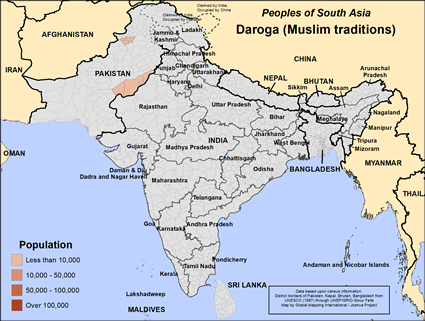
The Daroga with Muslim traditions are a community found in Pakistan within the broader cultural setting of South Asian Muslim society. Their identity has developed through generations shaped by Islamic influence, regional customs, family lineage, and village-based social structures common throughout parts of Pakistan. Urdu and regional languages are commonly used within their social environment.
Historically, communities such as the Daroga developed within tightly connected rural and semi-urban societies where family reputation, religious identity, and local customs strongly influenced daily life. Islamic traditions became deeply rooted over centuries through the influence of mosques, religious teachers, and inherited family practices.
Like many smaller communities in Pakistan, the Daroga have experienced social and economic changes through urban migration, modernization, and expanding educational opportunities. Even so, traditional family authority, religious observance, and community expectations remain highly influential.
Many Daroga families live in villages, towns, and developing urban areas where agriculture, labor, transportation work, trade, government employment, and small businesses provide income. Daily life often centers around work, family responsibilities, and relationships within the local community.
Meals commonly include flatbreads, rice, lentils, vegetables, yogurt, tea, and meat dishes associated with Pakistani cuisine. Hospitality is highly valued, and family gatherings, weddings, and religious celebrations remain important social events.
Extended family relationships often shape major decisions involving marriage, finances, and social obligations. Respect for elders and loyalty to family remain deeply important cultural values.
Many communities in Pakistan continue to face challenges involving poverty, inflation, healthcare access, educational limitations, and unstable employment opportunities. Flooding and infrastructure problems can also create hardship for struggling families.
The Daroga with Muslim traditions primarily follow Sunni Islam, which strongly shapes family life, religious identity, and social customs. Religious practices commonly include daily prayers, fasting during Ramadan, mosque attendance, observance of Islamic festivals, and respect for Islamic scholars and local religious leaders.
In some settings, Islamic practices may also be blended with folk beliefs, shrine-centered customs, spiritual superstitions, and traditions inherited through family and regional culture. This syncretistic mixture can influence spiritual understanding and daily decision-making.
Religious identity is often closely tied to family honor and social belonging. Because of this, following Christ may bring strong opposition, rejection, or isolation from relatives and the surrounding community. Many Daroga still have little opportunity to hear a clear biblical explanation of salvation through Jesus Christ alone.
The Daroga need greater access to faithful gospel witness presented clearly within their cultural and linguistic setting. Many have had limited exposure to biblical teaching or meaningful interaction with mature followers of Christ.
There is a need for believers who are willing to build long-term relationships, patiently answer spiritual questions, and disciple those who may face hardship or persecution for following Jesus Christ. Access to Scripture, Christian literature, and healthy local churches is important for long-term spiritual growth.
Practical needs are also significant in many communities, including healthcare access, educational opportunity, vocational training, and economic stability for struggling families. Compassionate Christian ministry can help demonstrate the love of Christ while opening doors for meaningful gospel conversations.
The Daroga would benefit from strong local fellowships capable of discipling believers, strengthening families, and continuing to share the gospel throughout surrounding communities.
Pray that the Daroga people will hear a clear presentation of the gospel and come to understand salvation through Jesus Christ alone.
Pray that God will raise up faithful believers and church planters who are willing to minister among the Daroga with wisdom, courage, and compassion.
Pray that the Daroga people will be adopted through the People Group Adoption program so that sustained prayer, outreach, discipleship, and future gospel engagement will continue among them.
Pray that Christians in Pakistan will grow in biblical faith and boldly share the truth of Christ with Muslim communities throughout the country.
Scripture Prayers for the Daroga (Muslim traditions) in Pakistan.
https://peoplegroups.org/explore/GroupDetails.aspx?peid=16279
https://www.britannica.com/place/Pakistan
https://www.britannica.com/topic/Islam
https://en.wikipedia.org/wiki/Islam_in_Pakistan
https://culturalatlas.sbs.com.au/pakistani-culture/pakistani-culture-religion
| Profile Source: Joshua Project |



