




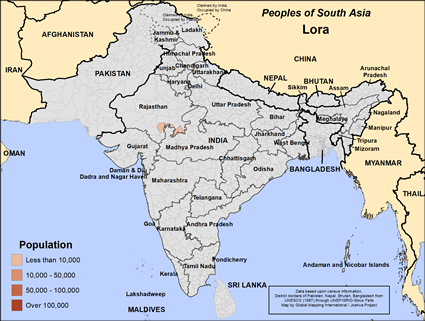
The Lora are a small tribal people group living mainly in the districts of Seoni, Betul, and Chhindwara in the central Indian state of Madhya Pradesh. They are recognized as a Scheduled Tribe, placing them among communities that have historically faced social and economic marginalization within Indian society. The Lora are associated with the Hindi-speaking cultural world of central India, though many tribal communities in the region also preserve local dialects and distinct customs alongside broader regional influences.
Historically, the Lora have been closely connected to the forests and rural landscapes of central India. Their traditional way of life involved hunting, gathering forest resources, and small-scale agriculture. Like many tribal groups in Madhya Pradesh, they have long depended on the natural environment for food, fuel, and livelihood. Over time, modernization, land pressures, and economic changes have increasingly affected traditional tribal lifestyles, leading some families to move into wage labor or farming.
Many Lora families continue to live in rural villages surrounded by forests, hills, and agricultural land. Traditional livelihoods have included hunting, gathering forest products, fishing, and subsistence farming. Some families cultivate crops on small plots of land, while others work as agricultural laborers or seasonal workers.
Family and clan relationships are important within Lora society. Extended families often remain closely connected, and village life tends to revolve around cooperation, local customs, and seasonal rhythms tied to agriculture and nature. Respect for elders and community traditions remains significant, especially in more isolated rural areas.
Food commonly includes grains such as millet or rice along with lentils, vegetables, and locally gathered foods. In forested regions, access to natural resources still influences daily life. Festivals, marriages, and community gatherings are important social events that strengthen family and tribal identity.
Economic hardship can affect many Lora communities. Some villages may struggle with limited healthcare access, inadequate education, poor transportation infrastructure, and unstable employment opportunities. Younger generations increasingly seek work outside their villages, though strong cultural ties to family and homeland often remain.
The Lora primarily practice Hinduism blended with tribal and folk religious traditions common among indigenous communities in central India. Their beliefs may include devotion to Hindu gods and goddesses alongside reverence for local spirits, ancestors, sacred places, and nature-related spiritual powers.
Religious ceremonies may involve offerings, seasonal rituals, village festivals, and practices intended to seek protection, healing, fertility, or blessing. Like many tribal communities, spiritual life is deeply connected to the natural world and daily existence rather than separated into formal religious categories.
Most Lora have had limited exposure to biblical Christianity or a clear explanation of the gospel. Many may know very little about Jesus Christ and have never encountered Scripture taught in a culturally understandable way.
The Lora need faithful access to the gospel through Scripture translation, discipleship, compassionate Christian witness, and long-term ministry relationships. Because tribal identity and traditional beliefs are closely tied to family and village life, individuals who become interested in Christ may face social pressure or isolation.
Practical needs include healthcare access, educational opportunities, vocational development, clean water, and economic stability in remote rural areas. Some communities also face challenges related to land use, poverty, and limited infrastructure.
There is a need for spiritually mature local believers who can establish biblically grounded churches and faithfully share the gospel among neighboring tribal communities throughout central India.
Pray that the Lora people will hear a clear and understandable presentation of the gospel in their own language and cultural setting.
Pray that God will raise up compassionate Christian workers who are willing to serve faithfully among the Lora communities of central India.
Pray that the Lora people will be adopted through the People Group Adoption program so that ongoing prayer and future gospel engagement will continue among them.
Pray that any believers living near the Lora community will grow in biblical faith and boldly share the truth of Jesus Christ with surrounding tribal peoples.
Scripture Prayers for the Lora in India.
https://peoplegroups.org/people_groups/pg048970/
https://www.britannica.com/place/Madhya-Pradesh
https://en.wikipedia.org/wiki/Scheduled_Tribes_and_Scheduled_Castes
https://www.india.gov.in/topics/tribal-affairs
| Profile Source: Joshua Project |



