




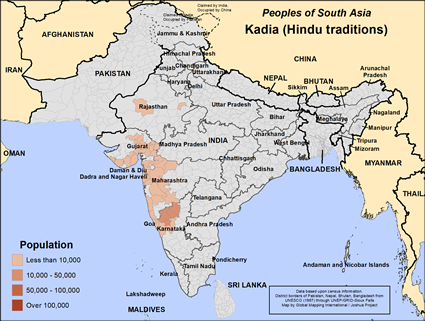
The Kadia are a Hindu community found mainly in the western Indian states of Gujarat, Maharashtra, and Karnataka. The word "Kadia" traditionally refers to a mason or someone involved in masonry and construction work, and this occupation has long been closely associated with the community. Over time, various caste groups connected with stonework, brickwork, pottery, and construction adopted the Kadia name or identity, especially in Gujarat and surrounding regions.
Historically, the Kadia developed within India's caste-based occupational system, where professions such as masonry, construction, and manual skilled labor were passed down through family lines. Many Kadia families became known for building houses, temples, walls, wells, and village structures. Some Kadia communities also trace links to Kumbhar potter backgrounds or Gurjar-related lineages, reflecting the complex social blending common within Indian caste history.
The Kadia primarily speak Gujarati or Kannada depending on their region, and many are bilingual in Hindi or regional languages used for trade and education. Community life is strongly shaped by family relationships, caste councils, local traditions, and village or neighborhood identity. Even as modernization has expanded economic opportunities, many Kadia families still retain connections to traditional construction and agricultural work.
The Kadia are traditionally masons, builders, and agricultural workers. Many families continue to work in construction, stone masonry, cement work, plastering, tile laying, carpentry support, and other skilled manual trades connected with building projects. Some work as independent contractors, while others labor for larger construction companies in towns and cities. Agriculture also remains important for some rural Kadia families.
Construction work is physically demanding and often unstable because employment depends on seasonal building activity and local economic conditions. Families may move temporarily between villages and cities following available work. In urban areas, some Kadia have entered transportation, business, education, factory work, and government employment, though many still remain economically modest compared to wealthier caste groups.
Village and family life usually center around extended family relationships and community cooperation. Men commonly work in construction or farming, while women often manage household responsibilities, assist with agriculture, and contribute to family income through labor or small trade. Weddings, religious festivals, and caste gatherings remain important social events. Caste councils continue to influence marriage customs, family disputes, and community relationships in some areas.
The Kadia generally practice monogamous marriage, and cousin marriages are typically discouraged. Divorce and widow remarriage are accepted in some Kadia communities, which distinguishes them from certain more socially restrictive Hindu groups. Family inheritance commonly passes through the male line, with the oldest son often taking leadership responsibilities after the father's death.
The Kadia are Hindus, and Hindu beliefs shape much of their personal, family, and community life. Religious practices commonly include temple worship, household rituals, pilgrimages, and observance of major Hindu festivals such as Diwali, Holi, Navratri, and Rama Navami. Depending on regional tradition, worship may focus on gods and goddesses such as Shiva, Krishna, Rama, Hanuman, Vishwakarma, Durga, or local village deities.
Among construction-related communities, Vishwakarma — regarded in Hindu tradition as a divine craftsman and architect — is often especially honored. Rituals connected with blessings for tools, buildings, and work projects may hold importance within community life. Many Kadia families also maintain folk religious beliefs involving astrology, ritual purity, blessings, curses, protective rituals, and local spiritual traditions alongside formal Hindu worship.
Like many Hindu communities, the Kadia often view religious identity as deeply tied to family heritage, caste belonging, and cultural tradition. Belief in karma, rebirth, and moksha influences moral thinking and religious practice. Religious festivals and temple activities also serve important social functions within the community.
Very few Kadia have had meaningful exposure to biblical Christianity. Christianity is often viewed as foreign or outside accepted caste and family identity. Social pressure and fear of community rejection can make openness to the gospel difficult. The Kadia need to hear clearly that forgiveness of sins and reconciliation with God come through Jesus Christ alone rather than through rituals, caste identity, karma, or religious tradition.
The Kadia remain largely unreached with the gospel, and there are relatively few known believers among them. Their integration into broader Hindu social structures and strong caste identity create barriers to Christian witness. Faithful Christian workers are needed who are willing to build long-term relationships, communicate biblical truth respectfully, and demonstrate the love of Christ through humility and practical service.
Practical needs vary between rural and urban communities. Many Kadia families continue to face unstable employment, physically demanding labor conditions, debt burdens, limited educational opportunities, healthcare access challenges, and economic uncertainty tied to seasonal construction work or agriculture. Younger generations increasingly seek advancement through technical education, migration, and urban employment opportunities.
The Kadia need Scripture resources, discipleship materials, and gospel teaching communicated in Gujarati, Kannada, and other local languages they understand clearly. Personal relationships, oral communication, family-centered ministry, and compassionate service may all help communicate the gospel effectively. Any believers among them would need encouragement, biblical training, and fellowship support because of social pressure connected to caste and religious identity.
Pray that the Kadia people will hear a clear presentation of the gospel and place their faith in Jesus Christ for salvation.
Pray that God will raise up faithful Christian workers who are willing to serve among the Kadia with wisdom, humility, patience, and compassion.
Pray that the Kadia people will be adopted through the People Group Adoption program so that churches and believers will commit to sustained prayer and future gospel outreach among them.
Pray that any believers among the Kadia will grow strong in biblical truth and boldly share the hope of Christ with their families and communities.
Scripture Prayers for the Kadia (Hindu traditions) in India.
https://en.wikipedia.org/wiki/Kadia_(term)
https://en.wikipedia.org/wiki/Kadia_Kumbhar
https://en.wikipedia.org/wiki/Gurjar_Kshatriya_Kadias
https://www.britannica.com/topic/caste-social-differentiation
https://en.wikipedia.org/wiki/Caste_system_in_India
| Profile Source: Joshua Project |



