




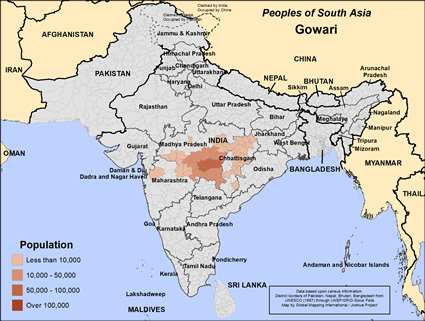
The Gowari are a pastoral tribal community found mainly in the Indian states of Maharashtra, Madhya Pradesh, and Chhattisgarh. Their name is closely associated with cattle herding and livestock care, and historically they were known as cowherds, grazers, and pastoral workers. Many Gowari traditions connect the community to the wider Gond cultural world, though the Gowari maintain a distinct identity of their own. In Maharashtra especially, debates over the relationship between "Gowari" and "Gond Gowari" have shaped community politics and legal recognition for decades.
Historically, the Gowari lived in forested and semi-rural regions where livestock grazing, cattle care, and agricultural labor formed the foundation of daily life. Oral traditions and older records describe them as herdsmen who moved cattle through forests and grazing lands while also working in farming communities. Over time many became landless laborers working for wealthier landowners or farming on small plots of land.
The Gowari speak mainly Marathi, though some also use regional dialects and neighboring tribal languages depending on location. Community identity is shaped by clan relationships, oral history, ancestral traditions, and a strong memory of social marginalization. In 1994, a major protest by the Gowari community in Nagpur ended in a deadly stampede that killed many protesters and became a defining event in modern Gowari history.
Although modernization has changed many aspects of traditional life, the Gowari still maintain strong cultural ties to pastoral heritage, rural community life, and ancestral customs.
The Gowari have traditionally lived as cattle herders, grazers, and agricultural laborers. Livestock ownership historically played an important role in their economy and social identity. Many families raised cattle, goats, or buffalo while also cultivating crops such as millet, sorghum, rice, wheat, pulses, and vegetables depending on local climate and land access.
In rural areas, many Gowari families continue to depend on agriculture and manual labor for survival. Men commonly work in farming, livestock care, construction, transportation, or labor-intensive occupations, while women contribute heavily through agricultural work, household management, gathering water and fuel, caring for animals, and raising children. Extended family relationships and village cooperation remain central parts of community life.
Many Gowari communities face economic hardship. Landlessness, unstable agricultural income, debt burdens, limited educational opportunities, and weak healthcare access continue to affect many families. Younger generations increasingly migrate to towns and cities seeking employment in factories, transportation, government work, and construction. This migration has created pressure on traditional village life and pastoral customs.
Community gatherings, weddings, seasonal festivals, music, and oral storytelling remain important for preserving Gowari identity. Respect for elders, loyalty to family, and strong communal ties are highly valued within the culture.
The Gowari practice Hinduism mixed with strong tribal and folk religious traditions. Their religious life includes worship of Hindu gods and goddesses along with reverence for ancestral spirits, local deities, and regional tribal powers. Many Gowari communities worship deified ancestors and local protective spirits connected to nature, livestock, family wellbeing, and village life.
Traditional beliefs involving blessings, curses, ritual protection, spirit influence, sacred places, and supernatural forces remain influential in many communities. Folk religion often shapes decisions involving illness, marriage, farming, livestock protection, and family wellbeing. Like many tribal and rural Hindu communities, Gowari religious practice is frequently syncretistic, blending formal Hindu worship with older indigenous spiritual traditions.
Major Hindu festivals such as Diwali, Holi, Navratri, and Rama Navami are commonly celebrated. Community rituals and seasonal observances often reinforce social identity and connection to ancestral traditions.
Although some Gowari may have encountered Christianity, many still have little understanding of the biblical gospel. Christianity is often viewed as foreign or outside accepted family and tribal identity. The Gowari need to hear clearly that forgiveness of sins and reconciliation with God come through Jesus Christ alone rather than through rituals, ancestral customs, karma, or fear of spiritual powers.
The Gowari remain largely unreached with the gospel, and there are very few known believers among them. Strong attachment to traditional religion, social marginalization, and limited access to clear biblical teaching create barriers to Christian witness. Faithful Christian workers are needed who are willing to build long-term relationships, communicate biblical truth clearly, and demonstrate the love of Christ with humility and compassion.
Practical needs are also significant. Many Gowari families continue to struggle with poverty, limited education, poor healthcare access, unstable employment, land insecurity, and social discrimination. Rural communities are especially vulnerable to drought, changing agricultural conditions, and economic instability tied to livestock and farming.
The Gowari need Scripture resources, discipleship materials, and gospel teaching communicated clearly in Marathi and related regional languages. Oral Bible storytelling, relationship-centered ministry, compassionate community support, and local discipleship efforts may all help communicate the gospel effectively. Any believers among them would need encouragement, biblical training, and fellowship support so they can stand firm in faith and share Christ within their own communities.
Pray that the Gowari people will hear a clear presentation of the gospel and place their faith in Jesus Christ for salvation.
Pray that God will raise up faithful Christian workers who are willing to serve among the Gowari with wisdom, humility, patience, and compassion.
Pray that the Gowari people will be adopted through the People Group Adoption program so that churches and believers will commit to sustained prayer and future gospel outreach among them.
Pray that Gowari believers will grow strong in biblical truth and boldly share the hope of Christ with their families and communities.
Scripture Prayers for the Gowari in India.
https://en.wikipedia.org/wiki/Gowari
https://timesofindia.indiatimes.com/city/nagpur/gowaris-are-independent-tribe-hc/articleshow/65407423.cms
https://indiankanoon.org/doc/167248492/
https://www.maharashtra.gov.in/pdf/Land%20&%20People%20%20Final/L%20&%20P%20pdf/Chapter%20II/2%20Major%20Castes%20and%20Tribes.pdf
https://www.forwardpress.in/2018/11/gowari-tribe-religion-culture-and-politics/
| Profile Source: Joshua Project |



