




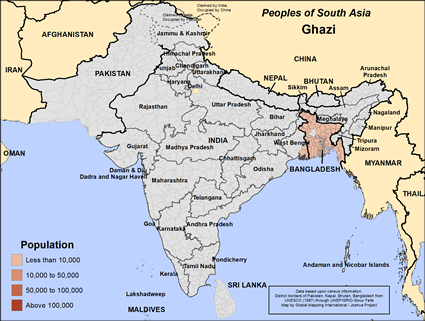
The Ghazi are a Muslim community found mainly in northern India, especially in Uttar Pradesh, Rajasthan, Haryana, Delhi, and neighboring regions. In many areas, the name "Ghazi" is associated with the Muslim Gaddi or Gaddi Muslim community. The Arabic word ghazi means "warrior" or "fighter for the faith," and over time it became both a title and a community identity among some Muslim groups in South Asia.
Historical traditions within the community vary. Some Ghazi trace their ancestry to Rajput or Kshatriya groups that converted to Islam centuries ago during periods of Muslim political expansion in northern India. Other traditions connect portions of the community to pastoral or agricultural backgrounds. Like many South Asian Muslim communities, the Ghazi developed within a social structure shaped by occupation, clan identity, regional culture, and biradari networks that regulated marriage and social relationships.
The Ghazi primarily speak Hindi, Urdu, Punjabi, Haryanvi, or regional dialects depending on location. Oral tradition, family honor, clan lineage, and religious identity remain important parts of community life. Many Ghazi families historically lived in rural villages, though increasing numbers now live in towns and cities because of migration, education, and employment opportunities.
Historically, many Ghazi families worked in agriculture, cattle keeping, labor, military service, and village occupations connected with rural life in North India. Some traditions describe the community as originally involved in cattle herding and farming before diversification into other occupations. Today, Ghazi families work in a wide range of occupations including farming, transportation, construction, government service, business, factory work, and urban wage labor.
Village life often centers around extended family relationships and close community cooperation. Men commonly work in farming, labor-intensive jobs, trade, or transportation, while women manage household responsibilities and may also assist with agricultural or informal economic work. Weddings, religious festivals, and biradari gatherings remain important social occasions that strengthen family ties and community identity.
Hospitality, respect for elders, and loyalty to family reputation are highly valued cultural traits. Marriage is usually arranged within the wider community or related biradari networks. Younger generations increasingly seek education and employment opportunities in urban areas, creating tension between preserving traditional identity and adapting to modern economic realities.
Like many communities in northern India, some Ghazi families continue to face economic instability, limited educational opportunities, debt pressures, healthcare challenges, and uneven access to stable employment. Rural agricultural families especially may struggle with land pressures, uncertain income, and seasonal labor conditions.
The Ghazi are Sunni Muslims, and Islam strongly shapes family and community life. Religious practices commonly include daily prayer, fasting during Ramadan, mosque participation, observance of Islamic festivals such as Eid al-Fitr and Eid al-Adha, and respect for the Quran and Islamic teaching. Religious identity is deeply tied to family tradition and community belonging.
Alongside formal Islamic practice, folk religious traditions and local customs may also influence daily life. In many North Indian Muslim communities, belief in blessings, curses, amulets, saints, shrines, dreams, and unseen spiritual forces remains influential. Some practices connected to local pirs or regional spiritual traditions may exist alongside orthodox Islamic teaching, creating a syncretistic religious environment.
Social identity among Indian Muslims is often shaped not only by religion but also by biradari and caste-like structures. Community honor, marriage customs, and inherited social identity frequently influence daily decisions and relationships.
Most Ghazi have had little meaningful exposure to biblical Christianity. Christianity is often viewed as foreign or socially unacceptable within Muslim society. Fear of rejection, family pressure, and religious conservatism can make openness to the gospel difficult. The Ghazi need to hear clearly that forgiveness of sins and reconciliation with God come through Jesus Christ alone rather than through religious identity, rituals, or inherited tradition.
The Ghazi remain largely unreached with the gospel, and there are very few known believers among them. Their integration into broader North Indian Muslim society and limited exposure to Christian witness create barriers to gospel outreach. Faithful Christian workers are needed who are willing to build long-term relationships, communicate biblical truth with humility and compassion, and serve among the Ghazi with patience and cultural understanding.
Practical needs vary widely between rural and urban communities. Many Ghazi families continue to face economic hardship, educational limitations, unstable employment, healthcare access challenges, and social pressures tied to class and community identity. Younger generations increasingly seek advancement through migration, technical education, and urban employment opportunities.
The Ghazi need Scripture resources, discipleship materials, and gospel teaching communicated in Hindi, Urdu, Punjabi, and related local languages. Oral Bible storytelling, audio Scripture, and relationship-centered ministry may be especially important in communities where literacy or direct exposure to Christianity is limited. Any believers among them would need encouragement, biblical training, and fellowship support because of strong social pressure surrounding conversion to Christianity.
Pray that the Ghazi people will hear a clear presentation of the gospel and place their faith in Jesus Christ for salvation.
Pray that God will raise up faithful Christian workers who are willing to serve among the Ghazi with wisdom, humility, patience, and compassion.
Pray that the Ghazi people will be adopted through the People Group Adoption program so that churches and believers will commit to sustained prayer and future gospel outreach among them.
Pray that any believers among the Ghazi will grow strong in biblical truth and wisely share the hope of Christ with their families and communities.
Scripture Prayers for the Ghazi in India.
https://en.wikipedia.org/wiki/Muslim_Gaddi
https://en.dharmapedia.net/wiki/List_of_Muslim_Other_Backward_Classes_communities_in_India
https://muslimmirror.com/casteism-among-indian-muslims/
https://indianhistorycollective.com/the-birth-of-a-community-ups-ghazi-miyan-and-narratives-of-conquest/
https://en.wikipedia.org/wiki/Garha
| Profile Source: Joshua Project |



