



The name of the Dholi comes from the word "dhol", meaning a type of drum. This is not surprising, since the Dholi have been drummers and musicians in India for centuries. They play drums during weddings and other festive occasions. The Dholi claim to have come from the powerful Rajput communities, but this is doubtful since they are currently a "scheduled caste." Scheduled castes receive special consideration for public jobs and university admissions. Like many Hindu communities, the Dholi perceive themselves as being higher on the Hindu social ranking order than others perceive them.
Work within the Dholi community is often shared across family members. Men usually take the lead in public musical performances, while women may assist with household responsibilities and, in some cases, participate in supportive roles connected to their cultural traditions. Because performance opportunities are often seasonal and event-based, flexibility in work is common, and many Dholi adapt to changing economic conditions by taking on various forms of labor.
Recreational life among the Dholi is strongly connected to their identity as musicians and performers. Music itself is not only a livelihood but also a primary form of enjoyment and expression. Gathering to play instruments, sing, and practice traditional rhythms provides both recreation and a way of preserving cultural heritage. These activities are often communal, involving extended family members and neighbors.
In everyday life, recreation may also include informal social gatherings, storytelling, and conversation, especially in the evenings after work. Children often engage in simple games and may learn musical skills from a young age, preparing them to continue the traditions of their community.
Festivals and social celebrations offer the most significant opportunities for recreation. During these times, the Dholi participate actively through music and performance, while also enjoying the communal aspects of feasting, dancing, and fellowship. Weddings are particularly important events, as they combine both work and enjoyment for the Dholi, allowing them to fulfill their traditional roles while taking part in the celebration.
The spiritual life of the Hindu Dholi is notable for the way it is closely intertwined with their role as musicians and performers within society. While they identify with Hindu traditions, their religious expression is often more functional and community-centered than highly formal or scripturally focused.
One aspect that can be considered distinctive is the connection between music and spirituality. As traditional drummers and performers, the Dholi frequently participate in religious festivals, temple events, and life-cycle ceremonies where music plays an important role in worship and celebration. Through their performance, they contribute to the spiritual atmosphere of these events, even though they may not hold positions of religious authority. In this way, their occupation places them near the center of religious activity, yet often without granting them higher ritual status.
Another notable feature is that their social position within the caste system has historically limited their access to higher-status religious roles. As a result, their spiritual life is often expressed more through participation and service than through leadership in formal religious practices. They may rely on local priests or other intermediaries for conducting rituals, while their own involvement is expressed through music, presence, and observance.
The Dholi may also incorporate local and folk elements into their religious practice. Like many rural Hindu communities, their beliefs can include reverence for local deities, spirits, or ancestral influences alongside the worship of widely recognized Hindu gods. These practices are often tied to immediate needs such as protection, health, and success in daily life.
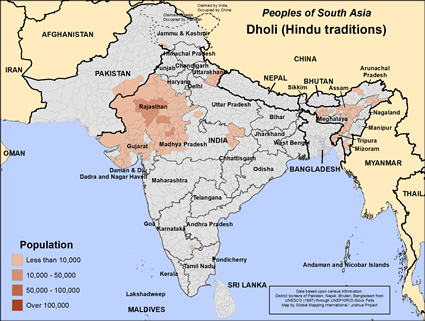
Most of the Dholi live in rural parts of India's scenic Rajasthan state. Smaller groups also live in the Indian states of Madhya Pradesh, Gujarat and Assam. These states have very few Christian believers, so the Dholi will probably never meet one.
Pray for the Lord to send workers to the Dholi to tell them of Jesus.
Pray that Christian materials in Hindi and Marwari would become abundantly available to the Dholi.
Pray for the Lord to send them literacy teachers.
Pray for spiritual hunger for the Dholi so that they will desire the word of God.
These Hindus listen to the radio and watch TV in Hindi. Pray for them to hear the gospel through Christian radio.
References
Scripture Prayers for the Dholi (Hindu traditions) in India.
| Profile Source: Joshua Project |



