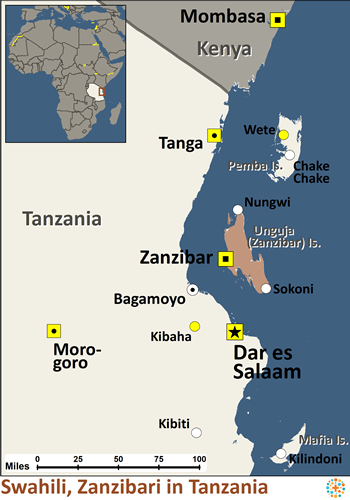

The name "Swahili" means "coastal dwellers" and refers to several related peoples who live along the eastern coast of Africa. The Zanzibari Swahili are those who come from the islands of Zanzibar, located just off the coast of Tanzania. They speak Swahili, a widely used language in East Africa that reflects a long history of interaction between African, Arab, and other trading cultures.
Zanzibar has historically been an important center of trade across the Indian Ocean, connecting Africa with the Middle East and Asia. Over centuries, these interactions helped shape a distinct Swahili culture that blends African roots with strong Islamic influence. Today, the Zanzibari Swahili maintain a deep cultural identity tied to their coastal heritage and the Islamic traditions that have been central to their society for generations.
Many Zanzibari Swahili live in urban or semi-urban settings, particularly in towns and coastal communities where trade, tourism, and small businesses play important roles in daily life. Their long history as coastal traders continues to influence their economic activities, with involvement in commerce, fishing, transportation, and service industries.
Family life is central to their culture, with strong emphasis on extended family relationships and community connections. Households often function within close-knit neighborhoods where daily interaction reinforces social bonds. Respect for elders and maintaining family honor are important values that guide behavior and decision-making.
Daily routines are shaped by both work and religious practice. Many people begin and end their day with prayer, and the rhythm of life is influenced by Islamic observances. Food commonly includes rice, fish, coconut-based dishes, and spices typical of coastal East African cuisine.
Traditionally, Zanzibari Swahili society has maintained clear gender roles. Women have often experienced seclusion in more conservative settings, while men have taken more public roles in work and community affairs. However, change is gradually occurring, especially as access to education increases and exposure to global culture grows.
Children frequently attend both Islamic schools, where they learn religious teachings, and government or private schools that provide a broader education. As a result, younger generations are increasingly influenced by outside ideas while still rooted in traditional values.
Social life often revolves around family gatherings, community events, and religious celebrations such as Eid. Music, storytelling, and shared meals are also important aspects of leisure, reflecting the rich cultural heritage of the Swahili coast.
The Zanzibari Swahili are entirely Muslim, and Islam deeply shapes their worldview, community life, and personal identity. They generally follow traditional Islamic practices, including regular prayers, fasting during Ramadan, and participation in religious festivals.
Islamic teaching influences moral values, social expectations, and life decisions. Religious leaders and teachers hold significant influence, and Islamic education is a key part of upbringing, especially for boys who often attend religious schools.
Because of their strong Islamic identity, many Zanzibari Swahili have limited understanding of the gospel and may view Christianity through negative or inaccurate assumptions. In addition, spiritual pride and confidence in their religious heritage can make it difficult for them to consider the message of Jesus Christ.
The Zanzibari Swahili have significant spiritual needs, as very few are followers of Christ and access to clear gospel teaching remains limited. While the Bible is available in Swahili, cultural and religious barriers often prevent meaningful engagement with its message.
There is a need for culturally sensitive outreach that demonstrates Christ's love through both words and actions. Building trust within communities and addressing misconceptions about Christianity are essential steps in making the gospel understandable.
In addition to spiritual needs, some communities face economic challenges related to employment, education, and development. Opportunities for quality education and stable livelihoods can vary, particularly outside major urban areas. Meeting practical needs alongside spiritual outreach can open doors for lasting relationships and transformation.
Pray that the Zanzibari Swahili would be adopted through the People Group Adoption program, resulting in ongoing prayer and faithful, long-term gospel engagement.
Pray that believers would be called and equipped to build genuine relationships with the Zanzibari Swahili and clearly share the message of Jesus Christ.
Pray that a deep spiritual hunger would arise among the Zanzibari Swahili, leading them to seek truth and follow Jesus no matter the cost.
Pray for improved access to education, economic opportunity, and community development that will strengthen families and open doors for hope.
Scripture Prayers for the Swahili, Zanzibari in Tanzania.
https://en.wikipedia.org/wiki/Swahili_people
https://www.britannica.com/topic/Swahili-culture
| Profile Source: Joshua Project |