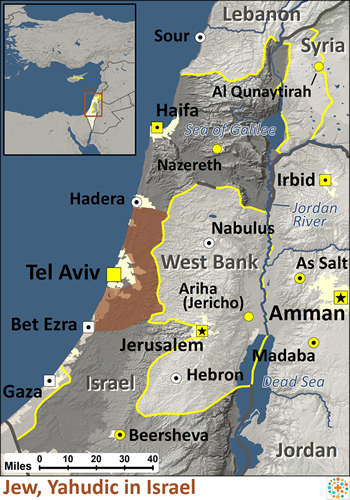

The Yahudic Jewish people in Israel are part of the broader Jewish population whose historical roots trace back to the ancient Israelites and the kingdoms of Israel and Judah in the land historically known as the Land of Israel. The term "Yahudic" is connected to the ancient word Yehudi or "Judahite," from which the English word "Jew" is derived. Historically, the Jewish people developed from the ancient Hebrew-speaking Israelites whose religious and national identity centered around covenant worship of the God of Israel, Jerusalem, and the temple traditions of ancient Judah.
After the destruction of the Second Temple by the Romans in 70 AD and later revolts against Roman rule, large numbers of Jews were dispersed throughout the Middle East, North Africa, Europe, and eventually many other parts of the world. Even during the centuries of diaspora, Jewish communities maintained strong historical, religious, and cultural attachment to the Land of Israel through Scripture, prayer, pilgrimage traditions, and shared identity. Small Jewish populations also continued living in the land throughout these centuries.
Modern Israel was established in 1948 following the Zionist movement and waves of Jewish immigration from Europe, the Middle East, North Africa, Ethiopia, the former Soviet Union, and other regions. As a result, Israeli Jewish society today includes many different cultural backgrounds such as Ashkenazi, Sephardi, Mizrahi, Ethiopian, Russian-speaking, and other Jewish communities. Hebrew was revived as a modern spoken language and became central to national identity.
The Yahudic Jewish population in Israel is therefore highly diverse culturally, politically, and religiously, yet united by shared Jewish identity, historical memory, Hebrew language heritage, and connection to the land of Israel.
Life among Jewish communities in Israel varies greatly depending on religious commitment, ethnic background, economic status, and region. Some live in highly modern urban settings such as Jerusalem, Tel Aviv, Haifa, or Beersheba, while others live in smaller towns, agricultural communities, settlements, or traditional religious neighborhoods. Israel is a technologically advanced nation with strong sectors in medicine, engineering, agriculture, military defense, education, and business.
Family life remains extremely important within Jewish culture. Holidays such as Passover, Yom Kippur, Rosh Hashanah, Hanukkah, and Sukkot continue to shape both religious and national life. Meals shared during Sabbath observance often remain central to family identity even among less religious Jews. Jewish traditions involving marriage, burial, festivals, and life-cycle events continue to connect many Israelis to their historical heritage.
Religious practice varies widely. Some Israeli Jews are Orthodox or ultra-Orthodox and organize nearly every aspect of life around Torah observance and rabbinic authority. Others are secular or only culturally Jewish, identifying strongly with Jewish history and identity while practicing little formal religion. Between these groups are many traditional Jews who combine modern lifestyles with varying levels of religious observance.
Israel's history of war, terrorism, political conflict, and military service has also shaped daily life. Most Jewish citizens serve in the military, and security concerns remain deeply woven into society. Immigration from many nations created both cultural richness and social tension as diverse Jewish communities adapted to life together within one state.
The Yahudic Jewish people primarily follow Judaism, one of the world's oldest monotheistic religions. Jewish belief centers on the worship of the God of Israel, reverence for the Hebrew Scriptures, covenant identity, prayer, moral law, and Jewish historical tradition. The Torah holds central importance within religious life, and rabbinic interpretation through the Talmud strongly shapes Orthodox Jewish practice.
Religious beliefs vary widely within Israeli Jewish society. Orthodox Jews generally believe in strict observance of Torah law and rabbinic tradition. Conservative and Reform Jews often interpret Jewish law more flexibly. Secular Jews may identify strongly with Jewish ethnicity and history while holding little personal religious belief. Mystical traditions such as Kabbalah also influence some segments of Jewish spirituality.
Most Jewish people reject Jesus as the Messiah and do not accept the New Testament as Scripture. Many continue to await a future messianic age connected to peace, restoration, and redemption for Israel. In modern Israel, Christianity is sometimes viewed through the lens of historical persecution in Europe, political conflict, or missionary pressure, which can create resistance to the gospel message.
At the same time, many Israeli Jews are spiritually searching. Secularization, modern materialism, political tension, and dissatisfaction with purely religious formalism have caused some to question traditional assumptions. Messianic Jewish believers in Israel remain a small minority and often face social opposition from both secular and religious Jewish communities.
The Yahudic Jewish people need to hear clearly that Jesus is the promised Messiah foretold in the Hebrew Scriptures and that forgiveness of sins and reconciliation with God come through Him alone rather than through ethnic identity, religious observance, nationalism, or human righteousness.
Although Israel contains churches, Messianic congregations, and access to Scripture, much of the Jewish population remains spiritually unreached regarding the biblical gospel. Many Israeli Jews have never encountered a clear New Testament presentation of Jesus as the Jewish Messiah rooted in the Hebrew Scriptures. Historical suspicion toward Christianity and fear of assimilation remain major barriers.
Messianic Jewish believers in Israel often face social rejection, family pressure, discrimination, or legal challenges connected to their faith in Jesus. Strong discipleship, biblical teaching, fellowship support, and mature leadership development are greatly needed within Messianic communities.
Practical and emotional needs are also significant. Israeli society continues to live under the pressure of military conflict, terrorism, political division, and regional instability. Many struggle with trauma, fear, secularism, loneliness, family stress, and questions about identity and purpose. Immigrant communities may also face language barriers, poverty, or social adjustment difficulties.
The Yahudic Jewish people need continued access to Scripture, gospel witness, and respectful conversations rooted in both the Old and New Testaments. Wise and compassionate ministry approaches are needed that honor Jewish history while clearly proclaiming Jesus as Messiah. Existing Jewish believers in Jesus need encouragement and boldness to share the gospel lovingly with their own people.
Pray that the Yahudic Jewish people will recognize Jesus as the promised Messiah and place their faith in him for salvation.
Pray that Messianic Jewish believers in Israel will grow strong in biblical truth and boldly share the gospel with wisdom, humility, and love.
Pray that the Yahudic Jewish people will be adopted through the People Group Adoption program so that churches and believers will commit to sustained prayer and future gospel outreach among them.
Pray that God will soften hearts throughout Israel and bring spiritual awakening among both religious and secular Jewish communities.
Scripture Prayers for the Jewish, Yahudic in Israel.
https://en.wikipedia.org/wiki/History_of_the_Jews_and_Judaism_in_the_Land_of_Israel
https://en.wikipedia.org/wiki/Israeli_Jews
https://en.wikipedia.org/wiki/Origins_of_Judaism
https://en.wikipedia.org/wiki/Israelites
https://www.ajc.org/news/who-are-the-jews
https://history.state.gov/milestones/1945-1952/creation-israel
https://www.hoover.org/research/jewish-roots-land-israelpalestine
| Profile Source: Joshua Project |