
People-in-Country Profile

Peoples Data Filter:
Print version:
Step 1 - Select a Country:   Send us your updates!
Step 2 - Select a People:  

Tuvinian, Uriankhai of Mongolia

Tuvinian, Uriankhai

Send us a photo of this people.  [1]

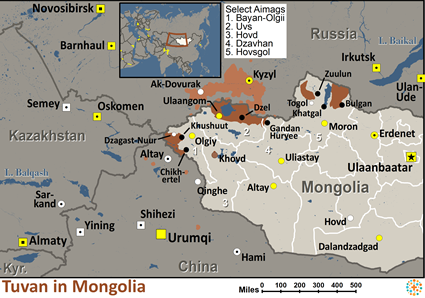
Tuvinian, Uriankhai of Mongolia map
Population [2] Language Religion % Christian % Evangl Online NT Jesus Film Progress
5,200 Tuva Buddhism 1.00 % 0.80 %  
1.2  

Tuvinian, Uriankhai of Mongolia

Profile Text
Submit Profile Text:

Introduction / History
The Tuvinian in Mongoloia inhabit a harsh mountainous region in the northern part of the country, near the border of Russia. There, the summers are hot and dry, while the winters are bitterly cold. Still, this region can have as many as 300 sunny days a year, and the extremely dry air helps people to withstand the cold winters and the hot summers.

Because the Tuvinian, like other Russian settlers, left their home territories in the Soviet Union many years ago and immigrated to Mongolia; their present "national" status is disputed. Some Tuvinian clans in Mongolia have maintained their native language, ethnic background, and traditional culture. Other Tuvinian clans have been absorbed by the Mongolian culture. Their original language, Tuvin, contains many Mongolian words and uses the Cyrillic script. Most Mongolian Tuvinian also speak Halh, the national language of Mongolia.

What are their lives like?
Most Tuvinian raise livestock for a living. They also hunt and do a limited amount of farming. Oats, barley, wheat, and millet, are the principal crops raised. Recently, farmers from northern China have introduced the Tuvinian to vegetable farming.

Many of the Tuvinian still live as nomadic shepherds, migrating seasonally with their herds. Those who inhabit the plains traditionally live in large felt tents called gers or yurts. Those in Siberia usually live in round tents made from bark.

The main industrial activity in the Tuvinian Republic is mining, especially for asbestos, cobalt, coal, gold, and uranium. Other industries include processing food, crafting leather or wood items, and manufacturing building materials.

The Tuvinian diet primarily consists of meat (mutton, beef, horse, goat, camel, reindeer, and wild game), fish, roots, cedar nuts, and dairy products. The Tuvinian enjoy drinking airag (fermented milk) on special occasions.

In times past, Tuvinian marriages were arranged by the parents, and couples married when they reached the age of 12 or 13. Today, the minimum age for marriage is 18 and parental consent is no longer necessary. A young bride formerly lived with the husband's family, but today the couple's home is determined by their economic conditions. Divorce is common among the Tuvinian and abortion is often used as a form of birth control.

The Tuvinian culture is noted for its rich, oral epic poetry and its music. The Tuvinian use more than fifty different musical instruments, and traveling ensembles often perform outdoors.

What are their beliefs?
The Tuvinian were traditionally shamanists (believed in an unseen world of gods, demons, and ancestral spirits) and Tibetan Buddhists. Today, one third of the Tuvinian are Buddhists, one third are shamanists, and the remaining one third are non-religious.

Tibetan Buddhism was first embraced by the Tuvinian in the 1700's. In the 1930's, the Soviets destroyed nearly all of the Buddhist monasteries, and all the monks were dispersed; some were even shot. Recently, however, a Buddhist community was officially registered in the Tuvinian Republic, and efforts are underway to rebuild a great monastery.

The influence of shamanism is still obvious among the Tuvinian. Ceremonies are held on the seventh and forty-ninth days after someone's death. The soul is believed to remain in the body of the deceased for seven days, then depart for the "kingdom of the dead," reaching its ultimate destination on the forty-ninth day.

The Tuvinian believe that all natural elements contain spirits that must be appeased with offerings. The people are dependent on shamans (medicine men) to cure the sick by magic and communicate with the spirits.

What are their needs?
Until Tuva become a part of Russia, very few of the Tuvinian men and none of the women could read. Perhaps Christian teachers will have open doors to work among the Tuvinian.

Prayer Points
* Ask the Lord to call people who are willing to go to Russia and share Christ with the Tuvinian.
* Ask God to use the Tuvinian believers to share the love of Jesus with their own people.
* Pray that Christian radio and television broadcasts will be made available to the Tuvinian.
* Ask the Holy Spirit to soften the hearts of the Tuvinian toward Christians so that they will be receptive to the Gospel.
* Pray that God will open the hearts of Russia's governmental leaders to the Gospel.
* Ask the Lord to raise up strong local churches among the Tuvinian.


View Tuvinian, Uriankhai in all countries.
Prayer Links  
PrayerGuard.net
Global Prayer Digest: 2006-08-26
Global Prayer Digest: 2009-07-15
  Submit Update:
Country: Mongolia
Continent: Asia
Region: Northeast Asia
10/40 Window: Yes
Total Provinces on file:4
Location in Country:North and west Monolia, Hövsgöl and Hovd Aimags
(Source: Ethnologue 2010)
   
 
Maps
Submit Map:
Country Map:Political map
 
  Peoples [3]
Submit Update:
People Name in Country: Tuvinian, Uriankhai
People Name General: Tuvinian
Alternate People Names:
Altai TuvaAltai Uriangkhai
DibaMonchak
MonjakMungak
ShorSoyod
SoyonSoyot
TokhaTuba
TuvaTuvin
TuwaUrinkhai
ROP3 Code: 110333
Joshua Project People ID: 15668
Indigenous: Yes
Population in Country: 5,200
Population all Countries: 273,000
Least-Reached: Yes
Engagement Status:Unengaged or Unknown
   
 
Affinity Bloc: Turkic Peoples
People Cluster: Ural-Siberian
People Name General: Tuvinian
Ethnic Code: MSY41z
Ethnic Relationships: Affinity Bloc -> People Cluster -> Peoples Ethnicity Tree
   
 
Language
Submit Update:
Primary Language: Tuva
Language Code (ISO): tyv    Ethnologue Listing
Secondary Languages:
Kalmyk-Oirat: Uriankhai (Unknown)
Total Languages: 2
   
 
Religion [4]
Submit Update:
Primary Religion: Buddhism
Major Religions:
Buddhism35.00 % 
Christianity1.00 %(Evangelical: 0.80 %)
Ethnic Religions30.00 % 
Hinduism0.00 % 
Islam0.00 % 
Non-Religious34.00 % 
Other / Small0.00 % 
Unknown0.00 % 
Christianity Segments:
Anglican0.00 %
Independent30.00 %
Protestant40.00 %
Orthodox0.00 %
Other Christian0.00 %
Roman Catholic30.00 %
 
(Evangelicals distributed across Christianity segments)
   
 
Progress Indicators [5]
Progress Scale[6] 1.2   Evangelicals >.01% but <=2%. Professing Christians <=5%
Least-Reached: Yes
Engagement Status:Unengaged or Unknown
 
 
Bible Translation Status
Submit Update:
Bible Portions: 2005
New Testament:
2002Online New Testament
Complete Bible: 2011
Possible Bible Sources: Forum of Bible Agencies
 World Bible Finder
 World Christian Resource Directory
 Gospel Go
 
 
Ministry Resources [7]
Submit Link:
Audio RecordingsMegaVoice Audio Bible and Stories
Audio RecordingsGlobal Recordings
Audio RecordingsOnline New Testament (FCBH)
Film / VideoJesus Film: view in Tuva
Film / VideoWorld Christian Videos
ScriptureWorld Scriptures
 
 
Ministry Activity
Register Ministry Activity:
Description: Register your ministry activity among this people group. Contact the Adopt-A-People Clearinghouse to learn about others that might be focused on this people group.
 
Data Notes
Data Sources


Tuvinian, Uriankhai of Mongolia

Peoples
               
Geographic
Global                 Global
           
  Affinity Bloc             Global  
           
   
People Cluster
       
Region
   
    Ural-Siberian     Northeast Asia    
     
People-Group-Across-Countries
   
Country
   
      Tuvinian Mongolia    
            People-by-Country (Profile)          
            Tuvinian, Uriankhai of Mongolia          
      Religion Language  
      Buddhism     Tuva  
    Global    
Language
 
    All Religions                              
   
Religion
                             

Direct link:  http://joshuaproject.net/people-profile.php?peo3=15668&rog3=MG