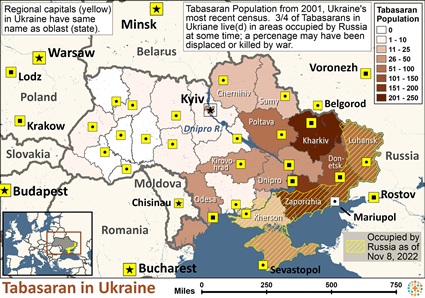

The Tabasaran are a people whose homeland is the Caucasus Mountains of southeastern Europe and southwestern Russia. Their primary occupation is agriculture and animal husbandry. A small group of Tabasaran lived in the southeastern part of Ukraine near Donetsk. Since the Russian invasion of February 2022, it is unknown whether the Tabasaran have remained in Ukraine or fled to the more peaceful Russian Republic of Dagestan.
The Tabasaran have been Sunni Muslims since the 8th century. The Russians conquered the Caucasus region in 1864. The Tabasaran are feared as fierce warriors when protecting their land and families.
In village Tabasaran culture, friendship and hospitality are the highest values. If a person has many friends, he or she is a 'wealthy' person. Within their culture, friendship and hospitality go with one another. If a guest comes to a Tabasaran home, everything else is dropped and the friendly relationship takes first priority.
Other salient features of Tabasaran culture are also evident: respect to the elderly, mutual aid in daily life and local artisanry such as carpet-making and Tabasaran music, the "godekan"—the male collective decision-making body at the center of each village, societal care for the sick and the poor.
The Tabasaran like all societies have their problems Male drunkenness has reached alarmingly high levels since the introduction of Russian vodka in the late 1800s. Blood feuds are common. Fear and shame are widely felt as controlling forces of traditional conformity. Cycles of vengeance and violence beset the region, along with fierce power struggles—capped by the omnipresent corrupt bribery demands, coming from those in power.
This striking combination of factors yields the following observation, "The Tabasaran culture, like other mountain Dagestani cultures, has many outstanding cultural historical strengths; but a tragic lack of grace, forgiveness, and agape love. Due to this redemptive deficit, in recent years even many of the historic strengths have been getting progressively dimmer due to the devastating effects of sin."
But, for the Tabasarans, new hope is springing forth. In 1997 the first Tabasaran-speaking person came to Jesus. This was followed by dozens more in the decade following, both in village regions and in urban regions of Dagestan. There are now more than 100 Tabasaran believers. In the midst of the fierce Muslim tensions of Dagestan, loving relationships—coupled with widespread prayer—hold the hope for further redemptive impact into the Tabasaran world.
The Tabasaran tend to marry within their group and have a large number of children. Some young people are choosing to leave the rural villages and settle in cities and towns. They are looking for better educational and economic opportunities. These young people frequently marry outside their people and blend into the Russian population.
The large majority of Tabasaran are Sunni Muslims. They believe that the supreme God, Allah, spoke through his prophet, Mohammed, and taught mankind how to live a righteous life through the Koran and the Hadith. To live a righteous life, you must utter the Shahada (a statement of faith), pray five times a day facing Mecca, fast from sunup to sundown during the month of Ramadan, give alms to the poor, and make a pilgrimage to Mecca if you have the means. Muslims are prohibited from drinking alcohol, eating pork, gambling, stealing, slandering, and making idols. They gather for corporate prayer on Friday afternoons at a mosque, their place of worship.
The two main holidays for Sunni Muslims are Eid al Fitr, the breaking of the monthly fast and Eid al Adha, the celebration of Abraham's willingness to sacrifice his son to Allah.
Sunni religious practices are staid and simple. They believe that Allah has pre-determined our fates; they minimize free will.
The Tabasaran need to hear the life-saving message of Jesus Christ. He alone can forgive their sins and grant them eternal life.
Ask the Lord to send workers to the Tabasaran people in Ukraine.
Pray for a just and lasting peace in Ukraine and in Dagestan.
Pray that the small number of believers would grow and share their faith with their family and friends.
Pray the Lord would raise up a growing movement to Christ in the Tabasaran community in this decade.
Scripture Prayers for the Tabasaran in Ukraine.
| Profile Source: Joshua Project |
| Other PDF Profile |