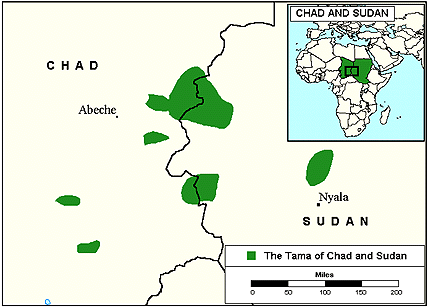
Poverty, drought, and violence characterize the lives of the Sinyar (or Shamya) people of eastern Chad and western Sudan. The Sinyar are a subgroup of the larger Tama speaking peoples. The government of Sudan has persecuted the Sinyar people in Sudan so that many have fled to Chad for safety.
The Sinyar are not Arabs. The northern Sudanese Arabs see them as inferiors. Most Sinyar people have only known war and violence for their entire lives.
Chad's independence from France in 1960, the country has seen a series of military dictatorships, civil wars, and politician assassinations. Chad is one of the poorest and most corrupt nations in Africa. As bad as life is in Chad, thousands of Sudanese refugees fled into Chad because of the ethnic cleansing in the Darfur region of Sudan. Chad has few resources to help these people.
There are few, if any, believers among the Sinyar. At present, there are no Scriptures or radio programs in their language of Sinyar.
The Sinyar make their living by agriculture and animal husbandry. The Sinjar people depend on rain for their crops and animals. Unfortunately, drought is common in the Sahel Desert in North Africa. When the crops do not receive sufficient rain, the Sinyar and their animals may starve. Malnutrition and disease are rampant among the Sinyar. Many children do not live to see their 12th birthday.
Some Sinyar men have left their families and work in Egypt or the Gulf countries, sending money home to their families. The Sinyar has an oral culture. Few can read or write. Some boys go to Muslim schools to learn the Koran and Arabic. A tiny group of wealthy Sinyar can send their sons to Khartoum or even Europe to get a formal education. These educated men become the administrators and representatives of the Sinyar regions.
The Sinyar live in village compounds. Walls of rocks, earth and wood keep out the lions, hyenas, and robbers. Sinyar houses are round and between 15-20 feet in diameter. Each village has a male chief who makes judicial decisions and deals with outsiders. Men spend their time taking care of animals and growing crops. They raise cattle, camels, goats, and sheep. These provide meat, dairy products, wool, and hides. The Sinyar grow peanuts, millet, sorghum, melons, onions, and other vegetables. Women help in the fields and care for their children. Although the Koran forbids drinking alcohol, the Sinyar brew, drink and sell their beer made from millet. Women supplement their family's diet by gathering berries, honey and grasses. Men hunt birds and antelope.
Men may have up to four wives if they can afford them. Most men have one wife. Children, especially sons, are viewed as blessings from Allah. Many children die before reaching adulthood. Sinyar men and women have as many children as they can. Grown children have the responsibility of taking care of their parents.
Life is hard for the Sinyar people. In years of drought, they become dependent on others for food, water and necessities. Food from the United Nations, Christian and Muslim relief agencies often do not reach the Sinyar but is taken and held by the Sudanese and Chadian governments.
The Sinyar claim to be Sunni Muslims. Folk religion and reverence for their ancestors heavily influence their Islamic beliefs. Sunnis try to obey the teachings of the Koran and the prophet Mohammad. Sunnis believe that by following the Five Pillars of Islam that they will attain heaven when they die. However, Allah, the supreme God of the universe, determines who enters paradise. Sunnis pray five times a day facing Mecca. They fast the month of Ramadan. They attend mosque services on Friday. If a Muslim Sinyar has the means, he or she will make a pilgrimage to Mecca once in his or her lifetime. Muslims must not eat pork, gamble, steal, deceive, slander or make idols.
The two major holidays for Sunni Muslims are Eid al Fitr, the breaking of the monthly fast and Eid al Adha, the celebration of Abraham's willingness to sacrifice his son to Allah.
The Sinyar have massive spiritual and physical needs. They need a regular source of water which drilled wells could provide. Radio programs in Sinyar could introduce the Sinyar to their Savior. Medical teams can bring modern medicine to the Sinyar. Their children need to learn literacy skills in order to take part in the 21th century. Most of all, the Sinyar people need to hear and understand the good news of Jesus Christ. He alone can forgive their sins and grant them eternal life.
Ask the Lord to send laborers into Sudan and Chad to share the love of Jesus with the Sinyar people.
Pray that Christian teachers will have open doors to start schools among the Sinyar.
Pray for a just and lasting peace in Chad.
Pray that God will lead linguists to translate the Bible and Christian materials into the Sinyar language.
Pray for radio programs in Sinyar language.
Ask the Lord to raise up strong, growing churches among the Sinyar of Chad.
Scripture Prayers for the Sinyar, Shamya in Chad.
| Profile Source: Joshua Project |