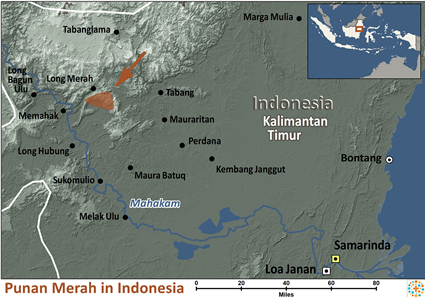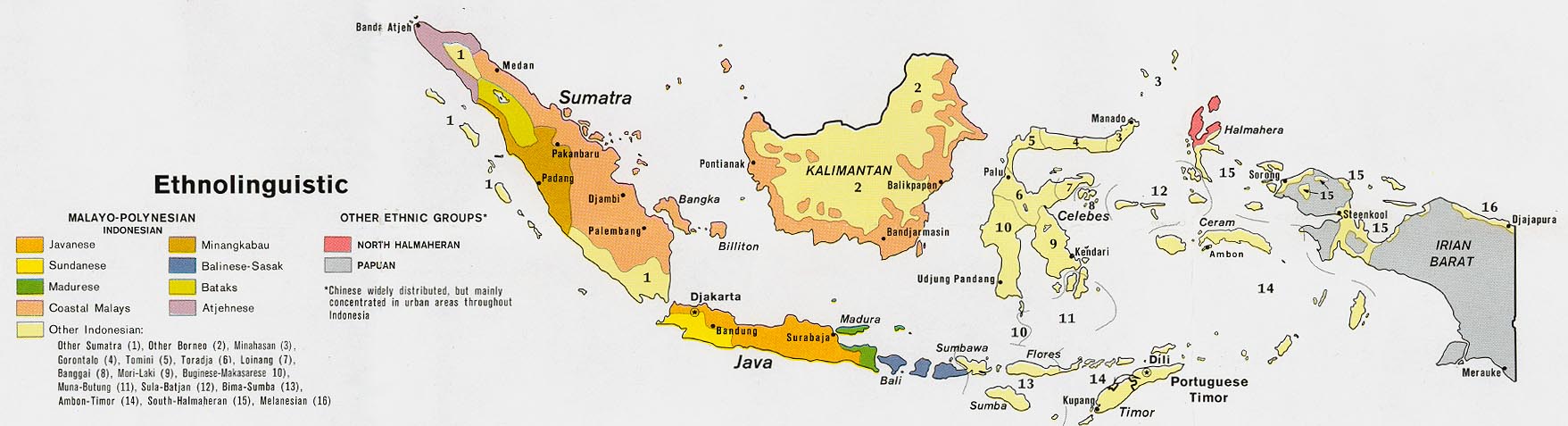
The Merah Punan, also known as Red Panan or Wana Merah, are one of the indigenous Punan peoples living in the Indonesian provinces of East Kalimantan and North Kalimantan on the island of Borneo. Their language belongs to the Austronesian language family, though the Punan peoples themselves are diverse and not all Punan groups share the same language or exact cultural background. The Merah Punan have historically lived in the dense rainforest regions of interior Kalimantan, an area long marked by isolation, river travel, and dependence on the forest environment.
Traditionally, the Merah Punan were semi-nomadic hunter-gatherers who depended heavily on the rainforest for survival. Over time, outside pressures, government settlement programs, logging activity, and contact with neighboring peoples encouraged many Merah Punan families to settle in permanent villages. Even so, some still maintain older forest-based practices and continue gathering forest products for food and income. Their identity remains closely connected to the forests of Borneo and the broader heritage of the Punan peoples.
The Merah Punan are part of the wider indigenous world of Borneo, where many tribal groups historically lived with limited outside influence. In recent decades, deforestation, mining, commercial agriculture, and migration have increasingly affected traditional lands and lifestyles throughout Kalimantan. These pressures have created both cultural and economic challenges for many indigenous communities, including the Merah Punan.
Though once primarily nomadic hunters and food gatherers, most Merah Punan families today live in settled villages. Hunting, fishing, gathering forest products, and small-scale farming continue to play important roles in daily life, especially in remote regions where forest access remains available. Some families cultivate rice, cassava, bananas, and other crops suited to tropical rainforest conditions. Forest products such as rattan, resin, or local plants may also provide supplemental income.
Life in the interior regions of Kalimantan can be physically demanding. Rivers often serve as the primary transportation routes between villages, and access to healthcare, education, and markets may be limited in isolated areas. Homes are commonly built from local wood materials, and village life is usually centered around extended family relationships and community cooperation.
The Merah Punan traditionally valued close ties to the forest environment, and older generations often possess deep knowledge of plants, animals, rivers, and survival skills passed down through oral tradition. Younger generations, however, are increasingly exposed to Indonesian national culture, modern education, mobile technology, and migration opportunities in towns and cities. These changes are gradually reshaping traditional community life and cultural identity.
Economic uncertainty remains a challenge for many families. Logging activity, land disputes, environmental degradation, and changing forest access can threaten traditional livelihoods and increase pressure to seek wage labor or urban employment.
The Merah Punan have traditionally followed ethnic religious beliefs closely tied to the spiritual world of the forest. Animistic beliefs involving spirits, sacred places, omens, and unseen supernatural powers have historically influenced many areas of life. Rituals connected to protection, healing, hunting success, and avoiding spiritual harm may still exist within some communities.
Among many Punan peoples of Borneo, traditional religion has often emphasized maintaining harmony with spiritual forces believed to inhabit rivers, forests, animals, and ancestral realms. Fear of curses, evil spirits, or spiritual imbalance may influence community practices and decision-making. In some places, outside religious influences such as Christianity or Islam have reached nearby communities, though traditional beliefs may continue alongside newer religious identities.
Most Merah Punan have had very limited access to clear biblical teaching and Christian discipleship in their own language. They need to hear that forgiveness of sins and reconciliation with God come through Jesus Christ alone rather than through rituals, spiritual appeasement, or fear of unseen powers.
The Merah Punan need greater access to the gospel through long-term Christian workers willing to live among them, learn their culture, and communicate biblical truth clearly and compassionately. Their remote location, small population, and linguistic uniqueness make sustained outreach difficult. Scripture resources and discipleship materials in forms understandable to the Merah Punan are especially important.
Practical challenges are also significant. Many indigenous communities in Kalimantan face pressures from deforestation, mining, land loss, economic instability, and limited infrastructure. Access to healthcare, quality education, clean water, and stable employment opportunities may be limited in isolated areas. Environmental changes can also threaten traditional food sources and cultural practices connected to the rainforest.
There is a need for compassionate ministry that addresses both spiritual and practical concerns while respecting the dignity of the Merah Punan people. Local believers, where they exist, need encouragement and biblical training so they can grow strong in faith and help reach neighboring communities with the gospel.
Pray that the Merah Punan people will hear a clear presentation of the gospel and place their faith in Jesus Christ for salvation.
Pray that God will raise up faithful Christian workers who are willing to serve among the Merah Punan with humility, wisdom, and perseverance.
Pray that the Merah Punan people will be adopted through the People Group Adoption program so that churches and believers will commit to sustained prayer and future gospel outreach among them.
Pray that any believers among the Merah Punan will grow strong in biblical truth and boldly share the message of Christ with their families and neighboring communities.
Scripture Prayers for the Punan Merah in Indonesia.
https://peoplegroups.org/people_groups/pg022599/?utm_source=chatgpt.com
https://en.wikipedia.org/wiki/Punan_Bah?utm_source=chatgpt.com
| Profile Source: Joshua Project |