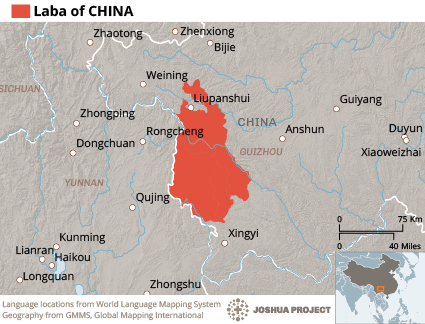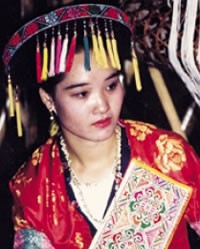

When Chinese scholars first visited the Laba in the 1950s they were unable to determine what ethnolinguistic relationship the Laba had with other groups. The Laba shared many of the customs of their Gha-Mu (Small Flowery Miao) neighbors yet seemed to only speak a form of Chinese. In 1985 the government officially reclassified Laba under the Miao nationality. One alternative name for the Laba is Huguangren. The Laba were probably a garrison of Han Chinese soldiers who were sent to Guizhou to fight the Miao. After hostilities ceased, the soldiers stayed behind, married local women, and gradually developed a separate ethnicity until they forgot their roots as Han Chinese people.
The customs and celebrations of the Laba also reflect both Miao and Han Chinese influences.
Ancestor worship and animism are the primary religious systems practiced by the Laba. The Laba believed the meat was able to nourish the souls of their forefathers in the next life.
The gospel has never taken root among this group as it has among other peoples in the area. More than two-thirds of the Gha-Mu (Small Flowery Miao), for example, are Christians. In 1998, gospel recordings were produced in the Laba language.
They need to know that God s ways should be embraced and obeyed. They need to see living Christianity in action.
Pray for a family-based movement to Christ to transform Laba society soon, blessing them spiritually and economically.
Pray for a Christ-centered revival in this community.
Pray for the Lord to move in the hearts of believers to give up their rights and sacrifice their lives to see the Lachi people blessed by the work of Jesus Christ, the only savior.
Pray that more people in this location will soften their hearts and open their ears to hear and heed the Lord.
Scripture Prayers for the Laba in China.
Operation China, Asia Harvest, Copyrighted Used with permission.
| Profile Source: Joshua Project |