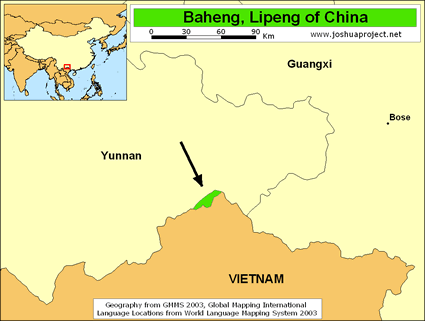

The Liping Baheng have been counted by the Chinese authorities as one of more than ten Bunu groups. Bunu is a generic term meaning "us people." The various groups of Bunu do not consider themselves related to each other and are dispersed over a vast geographical area. The Bunu were not granted status as their own minzu (nationality) in China but were included as part of the Yao nationality.
The Liping Baheng believe they are descended from eight ancient clans. Their name in Chinese, Ba Xing (Eight Clans), reflects this.
Liping Baheng women like to wear jewelry, including large earrings and necklaces. In the past, a newly married man was required to live with his wife in his in-law's house for 12 years. If the family gave their consent, he could build his own home after six years.
Ancestor worship is the primary religion among the Liping Baheng and is the driving force behind many customs and prohibitions in their society. Boys are highly valued because they believe only sons can conduct ancestral rites. Liping Baheng women often abort baby girls. China's strict implementation of family planning laws also encourages this.
The Baheng also observe many ancient animistic rituals relating to their practice of agriculture. They pray for the soul of the rice after planting, to ensure a successful crop. They have also been known to place drawings of corn, rice, or vegetables next to an altar in a bid to seek the blessings of the spirits.
Few of the Liping Baheng have ever heard that Christ died for them. They remain a completely unreached people group without a single known Christian.
Pray for the Liping Baheng to have the opportunity to encounter the gospel message.
Pray for them to be set free from the fear of their ancestors and spirits.
Pray for God's love to be demonstrated and preached among them.
Pray for the Holy Spirit to stir hearts and create a movement of Liping Baheng to Jesus.
Scripture Prayers for the Baheng, Lipeng in China.
Operation China, Asia Harvest, Copyrighted © Used with permission.
| Profile Source: Joshua Project |