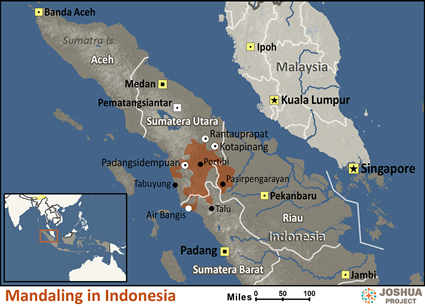

The Mandailing are part of the Batak cluster in North Sumatra Province. The Mandailing are a majority in the regencies of South Tapanuli and Mandailing Natal and in a few districts of Labuhan Batu Regency. They also live in the neighboring areas of Rokan Hulu, Riau Province and Pasaman, West Sumatra Province. The Mandailing are often called the South Tapanuli, after their main home area. This name (Tapanuli Selatan) is sometimes shortened to Tapsel. The Mandailing language is different than languages spoken by the surrounding people groups in the Batak cluster, such as the Angkola, Dairi, Toba, Simalungun, Karo, etc.
Most Mandailing people are wet rice farmers. A Mandailing person who leaves home will look for land and a house as expressed in the proverb "halului anak halului tana" (children and land). Children and land are viewed as sources of personal pride (sahala hasangapon) that cause one to receive status and respect. Someone who successfully settles in another area is esteemed very highly. Mandailing villages are called huta. Traditionally, the huta leader holds control of the land and only gives permission to members of the village to work the land. Members who own land are only allowed to work it; they are not allowed to sell it without permission from the leader and a discussion with other community residents.
The Mandailing people's religion in ancient times was a mixture of Hindu beliefs and a local traditional religon called Parmalin. Almost all Mandailing have been Muslims ever since Minangkabau Muslims forcibly introduced Islam. Many of their traditions have been adapted to Islam. The Batak peoples generally have three key ideas about the body and soul. First, tondi is the spirit of a person. The tondi can be temporarily separated from the body if a stronger and greater being (sombaon) takes it away. If this happens, a special ceremony is performed to return the tondi to the body of its owner. Second, sahala is the quality and amount of spiritual power that a person has. Third, begu are the spirits of the dead. They live in a reverse world: What people do during the day, the begu do at night. The Mandailing strongly identify themselves with the Islamic religion. This is a distinct departure from other Batak people groups which are predominantly Christian. The Mandailing constantly have to explain the fact that they are Muslims, since most Indonesians believe that all Batak peoples are Christian.
The Mandailing need to develop agriculture and education. Many are leaving their home area to continue studies or to find a better life. The area is rich in natural resources such as zinc, sulphur, limestone, granite, gold, copper, tin, petroleum and kaolin. There is tremendous potential that should be professionally developed, but investment is needed for this to happen. Better business and trade need to be developed.
Pray for spiritual discernment and a desire for truth.
Pray for loving workers.
Pray for Mandailing disciples who will make more disciples.
Scripture Prayers for the Mandailing in Indonesia.
IPN, 2011 Copyrighted © Used with permission.
| Profile Source: Joshua Project |